


Product-Vision
How UX can improve customer consulting at Debeka
Recently, I had a consultation about switching to private health insurance with Debeka. From a professional standpoint, it was really good: friendly, clear in its positioning, and highly competent in content—exactly what you would expect from personal advice.
And yet, something stuck with me that honestly surprised me: the software used to guide the consultation.
Not because “everything was bad”—but because in that moment it became clear how strongly an interface can influence the flow of a conversation. If the system is primarily an internal tool for combining tariffs, something happens during the call: advisors have to explain more than necessary, customers have to draw their own conclusions and lose the overview, and decisions become more cumbersome—even though this should actually be a moment where trust and clarity for something new are created.
This gap is a real opportunity. For Debeka—and for many insurers still working with similar advisory tools.
Our Appraach
Modern advisory software should support the moment of conversation and build trust: provide orientation, enable comparability, structure decisions—and support advisors as effectively as possible.
What can be improved
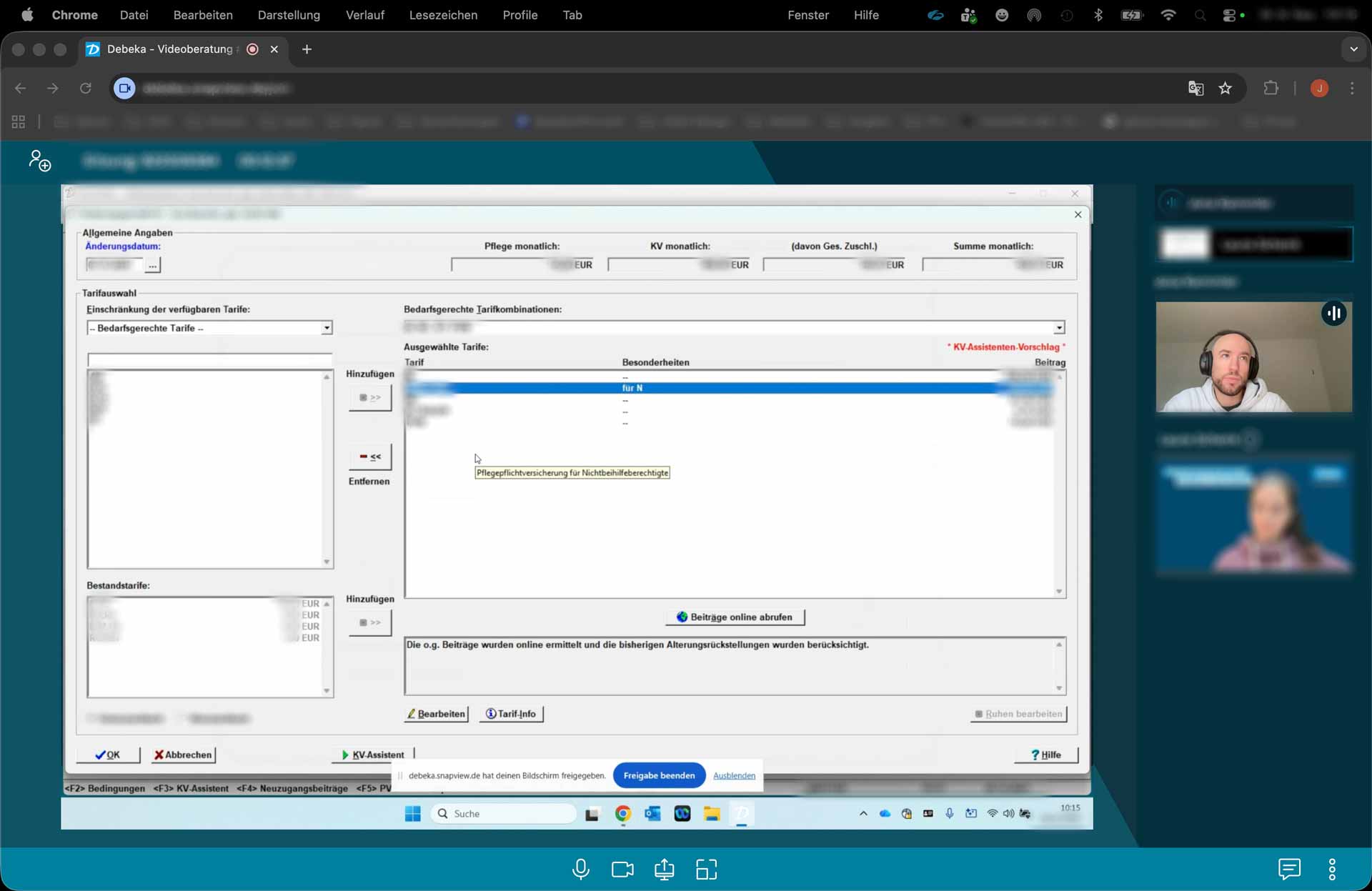
Names Instead of Codes
The application relies heavily on tariff abbreviations. Customers can hardly make sense of these terms. To avoid losing track, they write down codes and benefits in parallel—when they should actually be listening and understanding.
Comparability
The system does not provide a truly effective way to compare tariff options. Differences between variants are spread across multiple screens—the “comparison logic” therefore happens outside the system: on paper, in people’s heads, or through follow-up questions.
Enjoyment Instead of Note-taking
During the consultation, customers are busy taking notes, organizing information, and asking clarifying questions. As a result, the conversation feels technical and fragmented—even though it’s about a very personal decision.
Cognitive Relief
Many lists, little visual hierarchy, and no step-by-step guidance. Everything is visible at once—without prioritization. This makes decisions harder than they need to be.
What a Debeka solution could look like
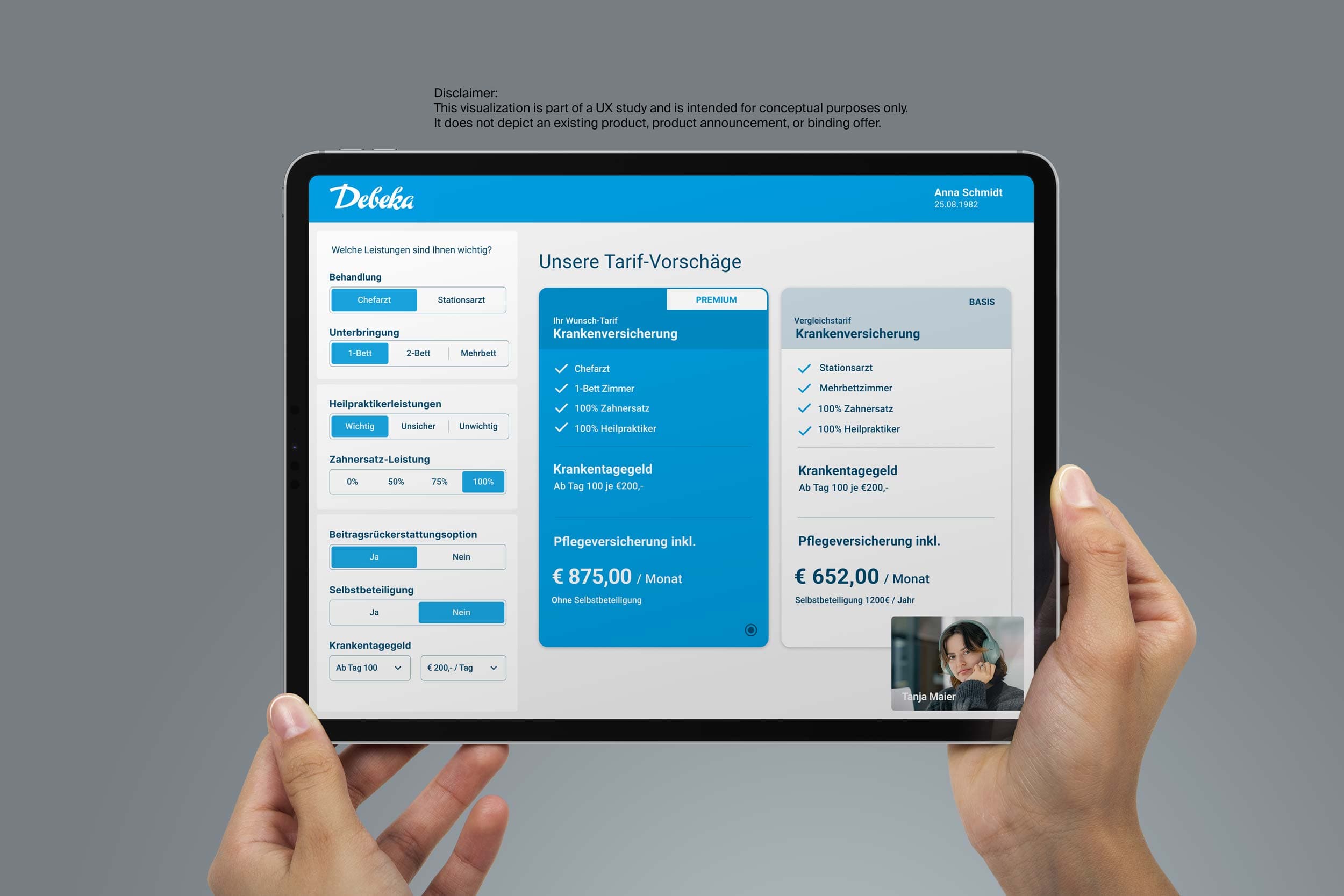
Clear Language
Benefits are presented in clear, human language—the way people actually make decisions. Tariff codes can still exist, but consistently remain in the background.
Comparison Logic
Options can be compared directly—not just as numbers, but in terms of impact: What does this mean in everyday life? What is added? What is removed? What changes in a tangible way?
Calm Design
Contemporary visual design is not a “nice-to-have.” It creates orientation, reduces stress, conveys professionalism—and supports trust.
Focus
Information is revealed step by step: first direction, then details, then fine-tuning. The conversation follows a natural decision-making logic—not the structure of the tool.
Was die debeka davon hat
When customers don’t have to translate, take notes, and organize information in parallel, more mental energy remains for what truly matters: their own situation, real questions, and a good feeling. The result: calmer conversations, fewer misunderstandings, and higher satisfaction—even if someone doesn’t make a decision immediately.
Transparency doesn’t come from more explanations, but from better comparability. This strengthens trust—and has a positive long-term impact on customer relationships.
When the tool takes care of comparison and structure, advisors can focus again on what they do best: contextualizing, guiding, and recommending—instead of translating system logic.
When comparability, clarity, and structured guidance come together in the initial consultation, fewer potential customers drop off and less follow-up is needed. Decisions are made faster and with greater confidence. This increases conversion rates while also shortening the time to close—without requiring more consultation time.
About the author
Jona Rammler is a UX expert and founder of Splore. He combines strategic design thinking, technical understanding, and high-quality UX/UI craft to create digital products with sustainable value.
In the podcast “Behind the Screens”, Jona Rammler and Jens Wienmann review digital products and real user experiences from a UX perspective and share insights from their analyses.

Questions?
Questions?
Get in touch with no obligation. Splore founder Jona Rammler is an expert in developing digital products and services.