

ux-design product development
More Product than UX: What is Shifting in Product Development
Recently, a client asked us for visuals. At first glance, a clear assignment: images, manageable in scope. During the conversation, the question arose about what these visuals should actually show. And with it, the question of what product is behind it. We were no longer dealing with images, but with conception and product strategy.
This is how many projects begin. At the start, the client does not yet know exactly what they need. This is not a criticism, but the norm.
It was similar in a project where we were supposed to develop a guideline for the User Experience. The feedback from product management was: You're actually building a product vision.
The word 'product' now appears everywhere. Job titles say 'Product' where they used to say 'UX'. Product Managers are more in demand than designers. Even PUSH UX now calls itself 'The UX & Product conference'.
Is UX currently migrating to product management and Product Design? And if so: Is the work just called something else, or has it changed? For companies, this is more than a question of terminology. It determines whether they order images or a product that works.
I discussed this with Samuel Lottner. Sam is a Director at peax, a recruiting agency for digital products. He sees which roles companies are filling and where talents want to move.
Clients are looking for UX, not Product Design
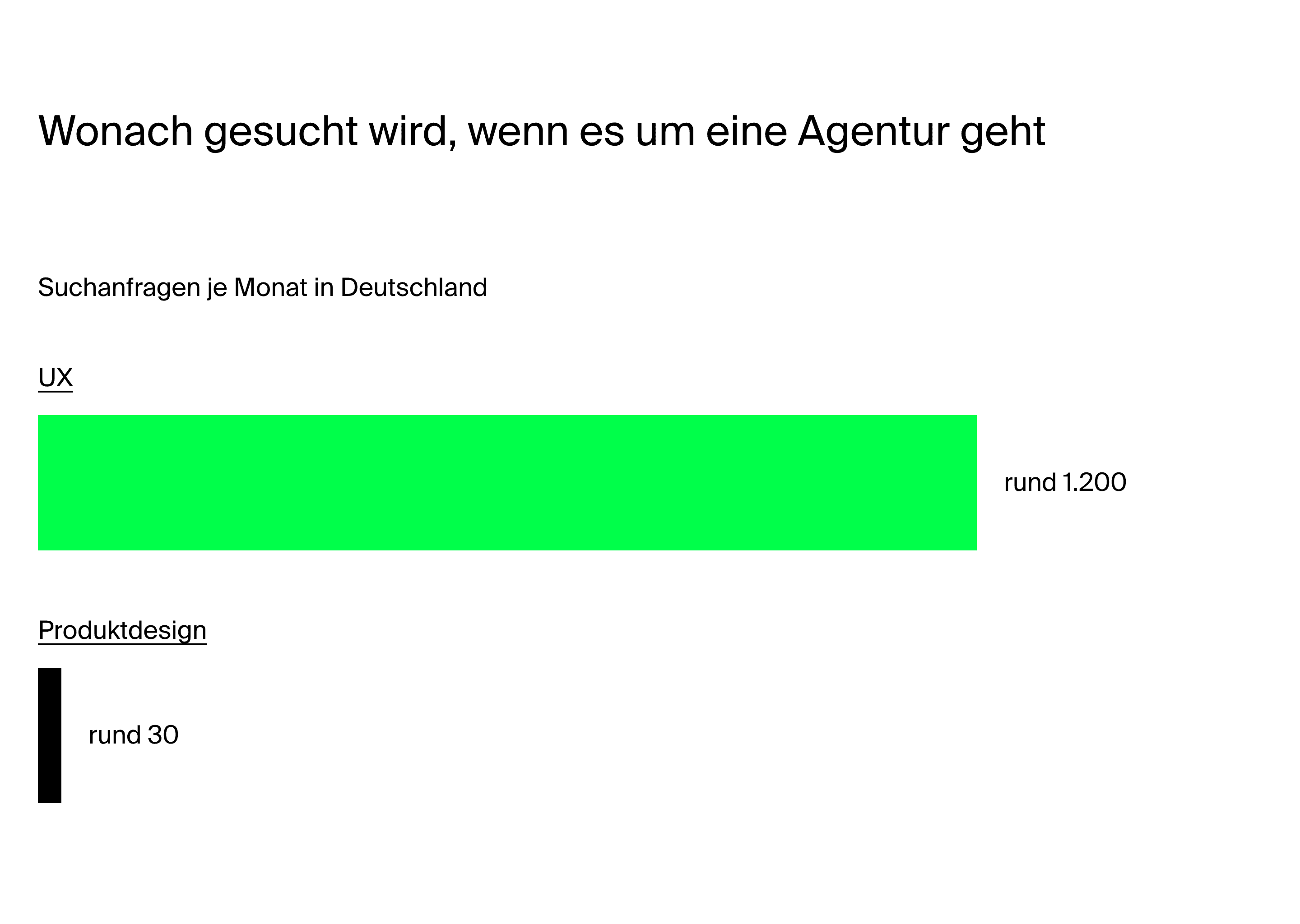
After the conversation with Sam, I would have guessed that there is an increasing demand for Product Design in Germany. The search data does not show this. Those looking for an agency or consultancy search for UX about 1,200 times a month. Hardly anyone searches for product design, about 30 times a month. And those who do usually mean industrial design.
Sam has an explanation for this. Perhaps we perceive such shifts primarily within our own bubble. Outside of it, the difference may hardly matter. He expects a consultancy to focus more on UX, product strategy, and innovation. 'Product Design already sounds more like an extended workbench.'
The request for visuals fits this. What was asked for was not product strategy, but images. For me, this means: We must demonstrate what UX can achieve through our work. Making it understandable how we work and the value we create is part of the job.
In the job market, the product is gaining ground
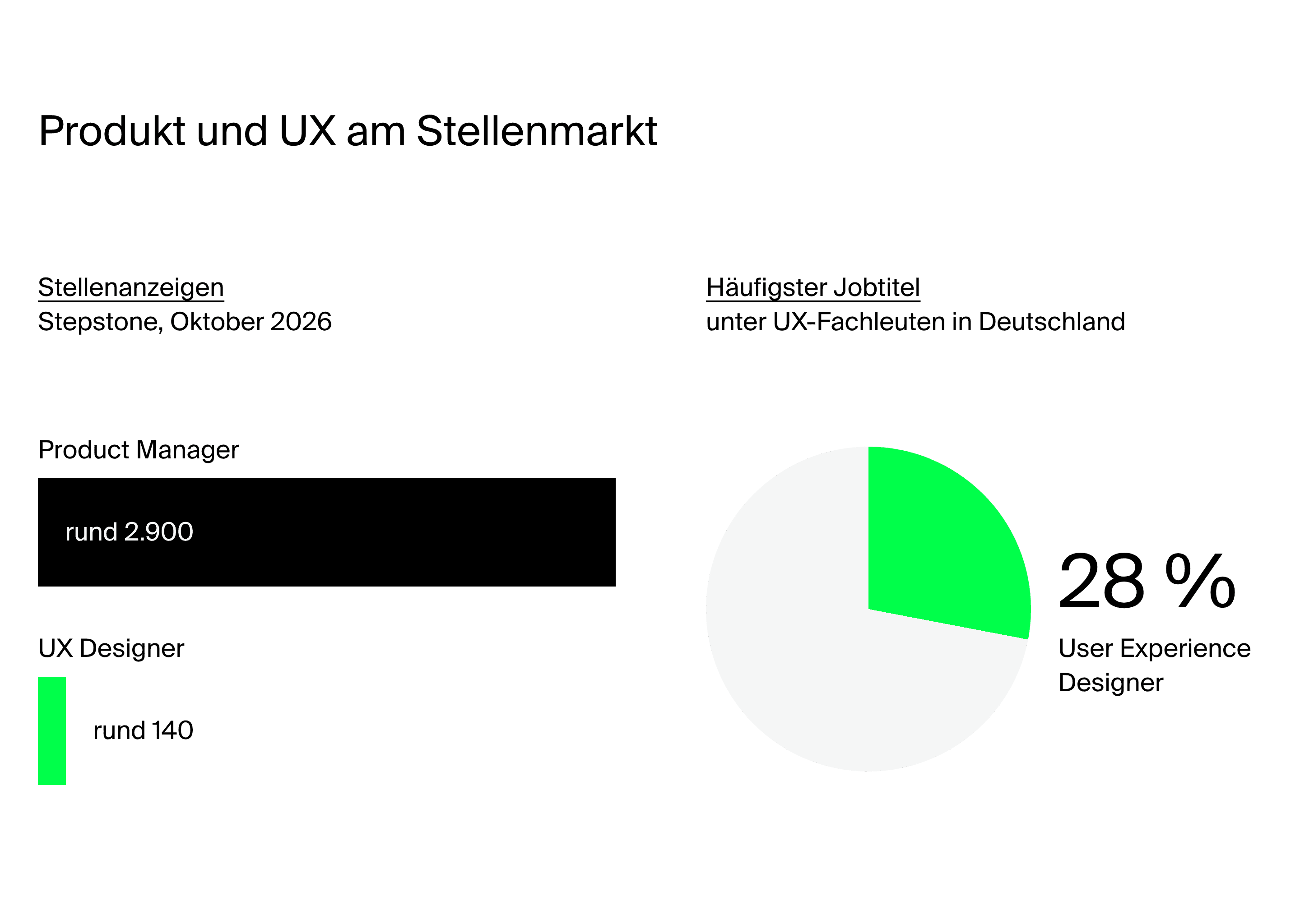
The situation is different with jobs. Lenny Rachitsky evaluated data from TrueUp in the spring: In tech companies, there are about a quarter more open positions for Product Managers than for designers worldwide. Consultancies are not included in this. In October, Stepstone listed about 2,900 hits for Product Managers compared to about 140 for UX Designers across all industries.
Sam also sees the trend in his placements, just 'not quite as extreme'. Product Manager is an extremely broad term. Therefore, the numbers are not directly comparable, but they still indicate the direction. Most frequently filled are Product Designers and Product Managers, followed by UX Designers. Many talents are currently seeking their next step in product management.
More weight for the product or just a new name? There is much to suggest the name. Two years ago, Sam says, UX was much more of a hype term, but the demand was much lower. Today, 'Product' is more appealing to both clients and employees. The professional association German UPA observes that 'UX' is increasingly being removed from job titles because roles are blurring. The most common title among UX professionals in Germany remains 'User Experience Designer', at 28 percent.
For me, User Experience is also the broadest term. It encompasses everything from research to conception.
And the weight? Product Managers define the requirements. When the design process arrives in a company, they often take on tasks that previously lay with UX. Product management usually involves people with a technical or economic background. They think in terms of features and business goals. UX first asks what problem the users actually have.
Both belong together. UX brings in the needs of the users and clear interactions, product management the market strategy and business goals. If both pull in different directions, it sounds like this. UX says: 'The users don't understand that.' Product management responds: 'Then we'll make an explanatory video for it.'
The approach is UX. The product is designed.
Where do I stand myself? My approach is UX because UX can demonstrate concrete product solutions. With the human-centered design process, we see what features a product needs and what a new product consists of. So it's more about the product than the UX.
In management, the demand for exactly this methodology is growing. Those who only focus on individual processes in the interface cannot meet it.
Processes remain important. Making complex workflows simple and thus helping people is my core competence. But the work doesn't start there. Many want to jump to the solution too quickly. Only when it is clear that we are solving the right problem do we develop solutions.
An example: One of the last inquiries came from a UX and development agency. Support was sought for interviews in Germany and the USA, for a medical device consisting of hardware and software. The task: find out what the product needs and then validate the concept. How we work on such projects, I describe underUX in Medical Technology.
My own path may explain why I see it this way: from designer to consultancy, today a consulting designer. At Deloitte, UX was part of Customer Experience and was considered a strategic value proposition. There I learned to switch between strategy and detail. Both must go hand in hand.
What is needed is someone who can go the whole way
AI and freely available pattern libraries now deliver solid standard solutions in a fraction of the time. For many tasks, that is enough. The pure implementation of UX is increasingly being automated.
Therefore, people are needed who align solutions with business goals. And who master the entire design process, from interviews in research to presentations to management. Those who want to have a say in portfolio decisions must speak the language of business.
Sam describes the same movement from recruiting. For him, the sought-after competencies are shifting from the how to the what and the why: away from the question of how to build something, to what should be built. Dealing with AI is now a mandatory criterion in placements. This aligns with the PUSH UX program: 'Product' rarely appears there, but AI does often.
AI is a natural part of the design process for us. In my experience, it delivers about eighty percent of a solution very quickly. The difference is made by the remaining twenty: recognizing which problem needs to be solved and working out the solution specifically. For this, specialized designers remain crucial. My term for this is Human-Crafted.
Whether companies hire this competence permanently or bring it in through a consultancy depends, according to Sam, on the predictability. 'As soon as predictability is there, permanent hiring takes place. That is hardly the case right now.' Neither economically and geopolitically nor in terms of which roles could be eliminated by AI.
What this means for companies
For executives and product managers, this is less a question of title than of approach.
1. Start with the problem, not the visuals.
Those who order images first set the solution before the problem is understood.
2. Pay attention to the whole journey.
Whether the role is called UX, Product Design, or product management is secondary. What matters is who can go from discovery to interface detail.
3. Bring product management and UX together early.
Otherwise, a usage problem becomes an explanatory video.
4. Use AI for breadth, humans for differentiation.
Standard solutions become cheaper. What sets a product apart from others will not.
The work is called differently, and it has changed
Partly, the new name is a trend. 'Product' is currently more appealing, Sam also says. But the work itself has really shifted: from workflow to product, from how to what.
My approach remains UX. What we design with it is the product. In the end, it all revolves around product, service, and customer. If UX does not occupy this central point, other disciplines will.
Many companies have strong strategy teams and excellent designers. Few connect both worlds. That is exactly where we work: from the question of whether a product solves the right problem to the detail in the interface that the development team implements. How this looks is shown by ourUX Services.

Are you wondering
what your product needs?
Are you wondering
what your product needs?
Contact us without obligation. Author and Splore founder Jona Rammler is an expert in the development of digital products and services.
Sources
1. Sistrix, search volume Germany per month, sum per term cluster (UX, product design), retrieved 23.10.2026.https://www.sistrix.de
2. Lenny Rachitsky, 'State of the product job market in early 2026', Lenny's Newsletter, data from TrueUp, 24.03.2026.https://www.lennysnewsletter.com/p/state-of-the-product-job-market-in-ee9
3. Stepstone, search 'UX Designer' and 'Product Manager', 13.10.2026.https://www.stepstone.de/jobs/UX%20Designer
https://www.stepstone.de/jobs/Product%20Manager
4. German UPA, 'UX dismantles itself – and becomes more powerful as a result', 02.07.2025.https://germanupa.de/blog/ux-zerlegt-sich-selbst-und-wird-dadurch-maechtiger
5. German UPA, 'UX/Usability Industry Report 2025: Between Enthusiasm, Reality, and Professionalization', 05.11.2025.https://germanupa.de/blog/ux-usability-branchenreport-2025-zwischen-begeisterung-realitaet-und-professionalisierung
6. PUSH UX, homepage and program 2026, retrieved 13.10.2026.https://push-conference.com/ · https://push-conference.com/program
Samuel Lottner: conversation and written responses, October 2026.